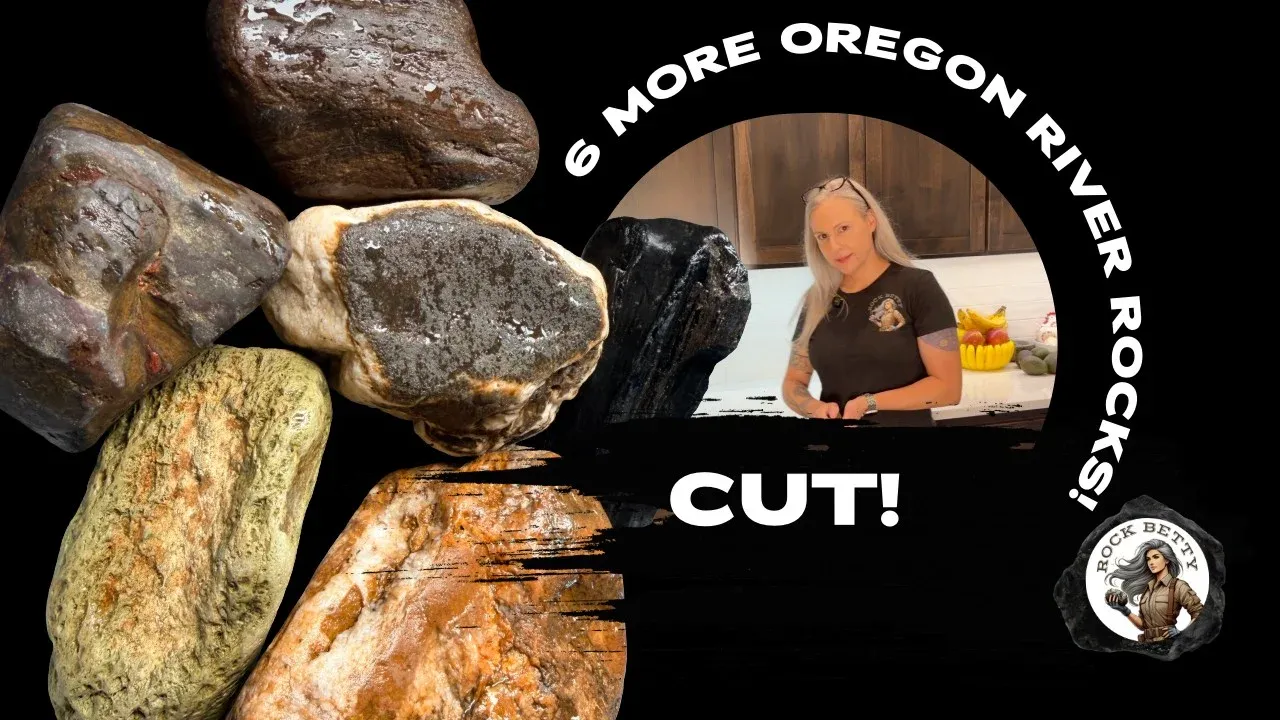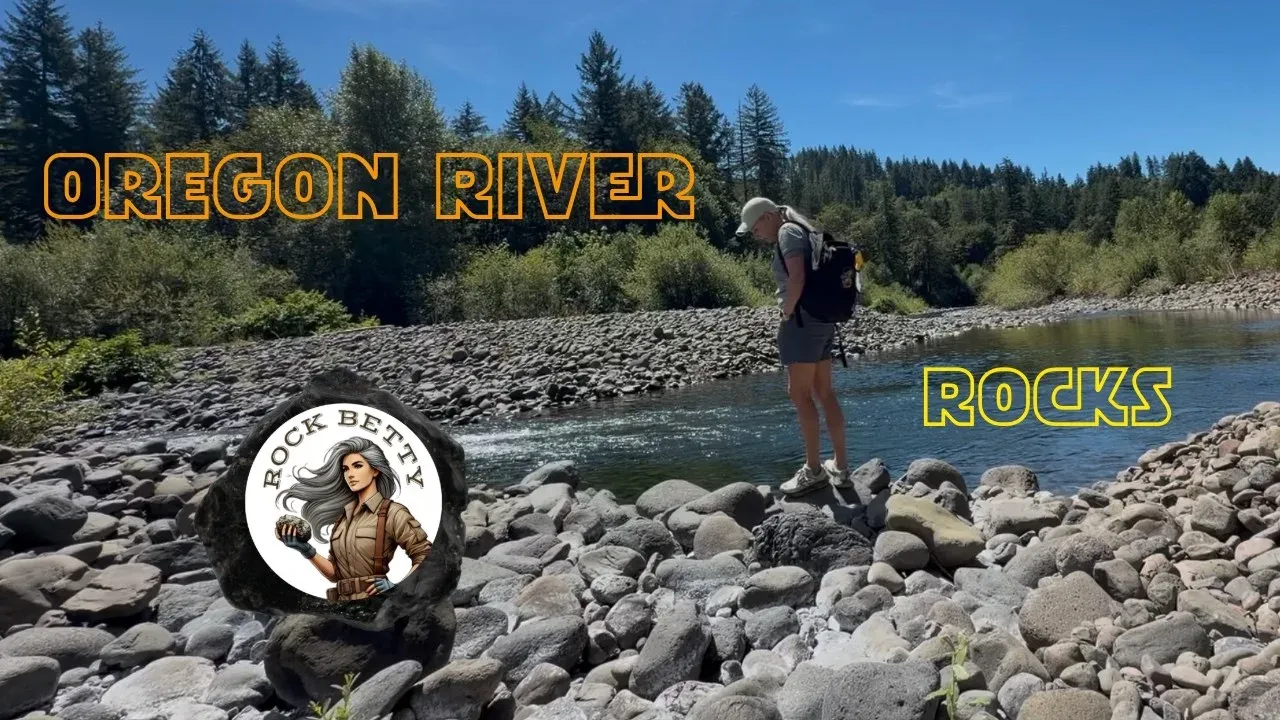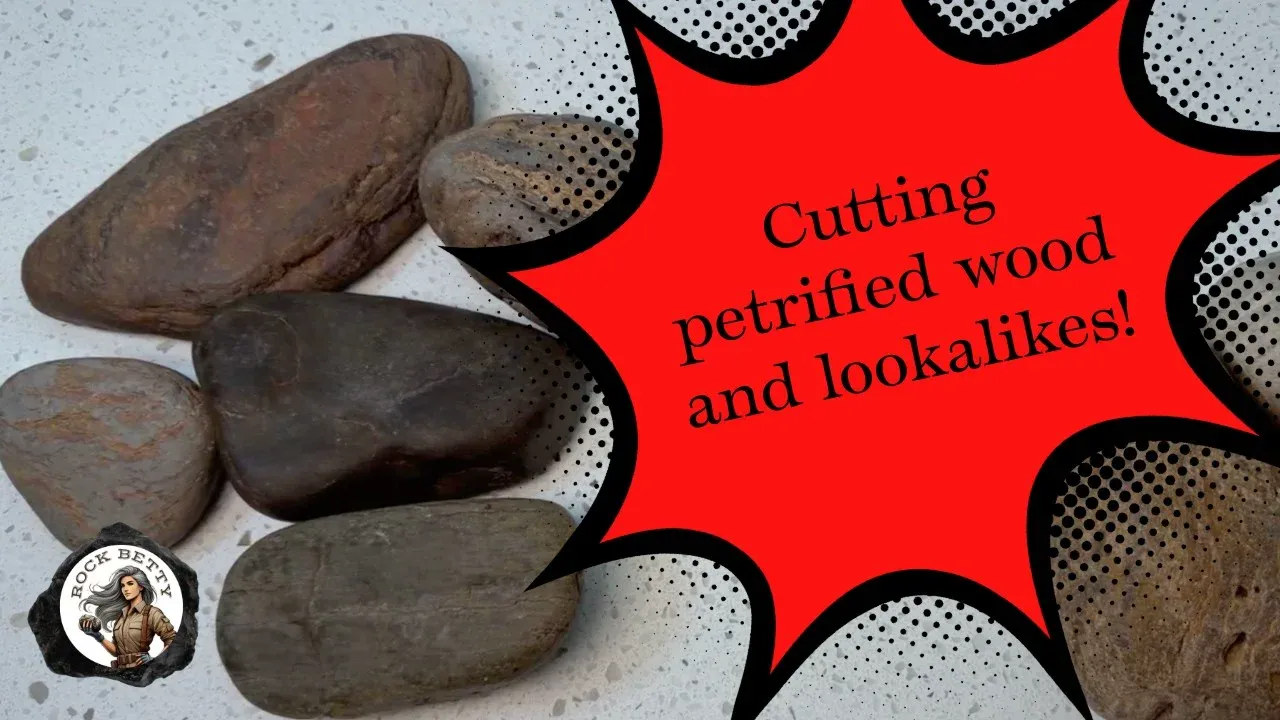
I gathered some rocks I’ve recently rockhounded from Oregon and Washington rivers and creeks: the Willamette, the Clackamas, the Washougal, and creeks in the Oregon Coast Range. Are these petrified wood lookalikes or petrified wood? I cut 11 rocks with my 10 inch Highland Park trim saw and show their interiors.
Watch the video:
Transcript
Beautiful petrified wood from Oregon and Washington. I’ve been fascinated with petrified wood ever since I was a little kid. Sometimes it’s obvious, and sometimes it isn’t. I have a bunch of pieces here that I found recently in Oregon and Washington rivers and creeks. Are they look-alikes, or are they really petrified wood?
Let’s cut them open and find out. There’s no question. Is this wood? It’s wood. But what about these rocks?
Are they wood? We have pieces from the Willamette River, the Washougal River, the Clackamas, and some coastal range creeks. Let’s cut them and find out. We’re starting with the rocks from the Willamette River. This piece looks like It looks similar to other pieces of petrified wood that I’ve found.
It looks like a giant piece of bark dust. Is this wood? Is it? I I may or may not still I may I still might not know, okay? It’s interesting.
I’ll give it that. It’s not an ugly rock. It’s very, very interesting. I take the blade marks out with my flat lap, and we’ll take a really close look at these at the end of the video. Here’s a fun one.
It looks reasonably like a piece of wood to me. And you have to imagine, you know, caked in scum. You know, I can only see maybe half of the rock. You might want to bring it home and check it out. This is a fossil.
We do know that. I’m not sure if it’s my optimism, you know, I really want everything to be a piece of petrified wood. Does everybody bring home look-alike rocks? This is a really neat rock. So, I’m not unhappy about bringing this home whatsoever.
Logically, I know it’s not true, but some of these rocks, I feel like Mother Nature’s just like, “Oh, we’re really going to get her this time. Wait till she sees this one.” It’s like It looks like wood. It’s normal to see patterns in everyday objects. Pareidolia is normal human behavior. I just think that there might be a little bit of an extra thing going on with me because if I see any lines or anything that’s at all reminiscent of wood, then I’m pretty driven to bring the rock home, cut it open, and find out.
I I can gaslight myself into and out of believing that a rock is a piece of petrified wood over and over again. If you want to be certain that a rock is petrified wood and you’re not sure, the only way to know for sure is to do a petrographic thin slice. And that is actually really difficult work to do. It’s very precise. It has to be 0.03 mm thick.
You can do it at home. Patrick Donohue of Donohue Labs has a video available showing how to do a thin section. I will put a link to Patrick’s video in the description. My friend Karen at Ozone Fine Art Ventures is working on a video about petrified wood identification, too. I’m really looking forward to that.
And I’m going to add a link to her channel in the description of this video, too. It’s tempting to just say, “Oh, it’s microcrystalline quartz.” And move on from there. Because I’m not sure I have enough time in my lifetime to do a thin section on all of these mystery rocks. I do have a microscope, a digital microscope that I sometimes use to take a deeper look at these rocks. And you know, that can help, also.
It’s just it’s not it’s not as definitive as a thin section. This is what keeps me interested. This is why I’ll never be done with rocks. They are full of surprises and mysteries. It absolutely never ceases to amaze me.
I’m not sure it’s realistic to positively identify every rock I find that I find interesting. I’m just not sure that’s feasible. But that’s what my brain wants. Luckily, my brain also wants me to spend a lot of time outside wandering around looking for more rocks. This one feels unexpectedly smooth on the inside.
I’m sure this is a siltstone. I can scratch it with steel. But I feel like I could probably polish it. It’s really cool. I find a lot of rocks like this one.
And I think it’s a fossil. I think these are stromatoporoids. But they look convincingly like what at times, especially if only part of the rock is clean or you know, I mean, they they have these cellular structures and they have grain. So, yeah, I have some really convincing stromatoporoids, I think. This one is beautiful.
We’ll take a closer look at this in a minute, but it’s just got so many crazy layers. Woah, that’s crazy. I would love to hear what you think if you have seen some of these rocks before. If you know that I’m wrong about one of them. Anything at all, please feel free to comment.
I love to hear from my viewers. A lot of times the petrified wood that I find in Oregon and Washington is very, very dark and it’s quite hard to see the details. And some petrified wood will bleach, but I haven’t had much luck with bleaching the pieces that I found that are black. I’ll keep trying. This piece from the Clackamas River looks a lot like a sandstone nodule I found on the Oregon coast a couple years ago.
And it looks like sandstone color-wise, but I can’t scratch it with steel. And I’m not convinced this isn’t wood. It even shows grain marks where it fractured here. We get a fair amount of green petrified wood in Oregon from the Hampton Butte location. But I don’t I’ve I’m not I haven’t seen a lot of this light green color before.
I don’t know. It’s a good candidate for a thin section. These last two rocks are both from Oregon Coast Range creeks. I really love the Oregon Coast Range. It’s a great place to explore, hike, just be out in nature, and there’s some beautiful rocks out there, too.
This last rock, well, these these these holes on the outside of this piece are sort of a dead giveaway. Um they’re definitely from ship worms, which would make this theoretically a piece of Toredo wood. Um and, you know, this one helped me identify the one prior here because it’s it’s the same wood, the same the same colors, but the other piece just didn’t have Toredo or ship worms in it. Um yeah, it has this great camouflage sort of murky gray-green look to it. Um and it was, you know, chewed up by ship worms, which are still destroying wood today.
Really cool. Wow. Come on, that is so freaking beautiful. Is this banded iron masquerading as petrified wood? Or is this petrified wood doing its best to look like banded iron?
Gorgeous. Starting strong. What’s it look like on the inside? Woah. Well, that’s really cool.
That’s a really pretty piece of jasper. Okay, ready? Wow. Well, that’s interesting. I not to look at these rocks very much before these moments so that I can well, be fresh with my words and I just my reaction.
And I don’t know what to think about this rock. I don’t know. Yeah, I really don’t know for sure. That’s an oddball. Go figure.
And let’s take a look at this one. Oh, that’s right. Oh, no. I forgot I have to hold this one together. Interesting little fractures.
Mhm. Okay, baby. Ready? Wait. There we go.
Okay. So, this one’s kind of green, stripy, looks very wood-like. Right? Got to be. I didn’t even get the blade marks out of this half because of the fracturing.
Well, this is gorgeous, too. Gorgeous. Glad I cut that. Last one from the Willamette in this group. Woah.
Woah. Gorgeous. Neat pattern in here. Wow. That’s great.
I love this one. Oh, how cool. That one’s wicked. I love that. I really like that.
Okay. All right. Next group. Now, the rocks from the Washougal. What’s it look like on the inside?
Very dark. Can just barely see that grain in there. Pretty cool. I mean, this really It’s of snail like has a little bit of a a snail appearance. That is gorgeous.
Awesome. Last one from the Washougal. Interesting. Strange. What’s it look like on the inside?
Woah! Oh my gosh. Okay. Is this another stromatoporoid? I think so.
Holy moly, what a cool rock. Let’s take a closer look at one of these. I mean, I just cannot believe there’s so many layers in there. They’re all so different. That’s pretty neat.
Gosh, that’s cool. Mhm. Really cool. We have this one from the Clackamas. Oh, see you soon.
No peeking. This one from the Clackamas River, and these two are from Coast Range creeks. Guess we’ll choose this one first. Definitely a lot of metal. Iron and hematite getting their way in to these rocks.
What’s it look like on the inside? Hard to see. Man, there’s a lot of glare. Nothing but glare. Very hard to photograph.
I got real dark one there. Cool. Very fun. It looks neater than it looks on camera, unfortunately. Okay.
Second one from Oh, wait. No, no, no, no, no. Let’s go in order of size here. The one from the Clackamas. Real neat.
Some strange crisscrossing lines here. Very not looking little structure here. Um Well, what’s she look like on the inside? Whoa. This piece fractured when I was cutting it.
You can see grain even in the fracture. A bit. Oh. Yeah, right there. There we go.
Kind of neat. Okay. I don’t know. Really pretty. Very pretty.
Very very destructive little creatures, but you know, they make beautiful fossils for us. So, um What’s it look like on the inside? Woah. I don’t know. It’s like they turned it to mush to me.
That’s neat. Way cool. Murky. I was pretty sure that this was a piece of wood. Yeah.
I mean it looks very much like a piece of wood. Then I found this one. This one really looks like a piece of wood. I mean doesn’t that look like wood? Right?
So, I thought I was finding wood. Look at all this great wood I’m finding. You know, look at me go. And then I found this one. These were all on the same day, same river.
You know, these have been on my counter for a few days and I was pretty sure I you know, had these great pieces of wood. And I can’t wait to cut these. It’s wood, right? And I started looking at this one a little bit closer. And if this is wood, where’s where’s the end grain?
Where is it? There’s no end. How can that be? Is this a stromatoporoid too? If these are stromatoporoids, man, they are doing their absolute best doing the absolute most to look like a piece of wood as far as I’m concerned.
I mean, you got little knot-looking things. That’s not a knot. That’s not a knot. I don’t know. If this is if this was wood, where wouldn’t there be an end to the grain?
So, I don’t know. Am I the only one that gets confused? Is this clear to everyone else? Are any of these three wood? How could that not be wood?
You know, I don’t know. I don’t know. I’ll never stop looking at them because it’s fascinating. I don’t know. What would you think?
Just looking like wood. Doing their most to look like wood. Yeah. So, it’s not always clear. Oh, but sometimes it is.
I found this piece on the same day in the same area. This one’s much more clear. You know, nobody’s wondering. We know that we have a decent massive piece of wood here, pretty good chunk. So, I don’t know.
Sometimes I don’t want to cut them. That makes it pretty hard to be certain. And even And as you’ve seen, even when you do cut them, it’s hard to be certain. I can’t wait to cut the next rock. See you soon.
Beautiful petrified wood from Oregon and Washington.